In this article (6 sections)
Pay-per-click advertising remains one of the most powerful customer acquisition tools available, when it's understood and executed correctly. The problem isn't that PPC doesn't work. The problem is that most brands run campaigns without understanding the underlying mechanics, then wonder why the results don't match the promise.
This guide covers everything you need to know, whether you're brand new to paid advertising or trying to understand why your current campaigns aren't performing.
What Is PPC Advertising, Really?
Pay-per-click is exactly what the name suggests: you pay each time someone clicks your ad. But the simplicity of the model hides a lot of complexity beneath the surface. You're not just buying clicks, you're participating in a real-time auction for the attention of a specific person at a specific moment with a specific intent. Understanding the auction is what separates profitable campaigns from expensive ones.
The two dominant PPC platforms today:
- Google Ads: Intent-driven. People are actively searching for a solution. Higher intent, higher CPC, higher conversion rates
- Meta Ads (Facebook + Instagram): Interest and behavior-driven. People aren't searching, you're interrupting their feed with something relevant. Lower intent, lower CPC, requires stronger creative
The best PPC strategies use both platforms at different stages of the funnel, rather than treating them as alternatives.
How Google Ads Actually Works
Google Ads isn't simply a "highest bidder wins" auction. The placement and cost of your ads are determined by a formula that rewards relevance as much as budget.
The three factors Google uses to rank ads:
- Bid amount: Your maximum cost-per-click, but this isn't the primary determinant of placement
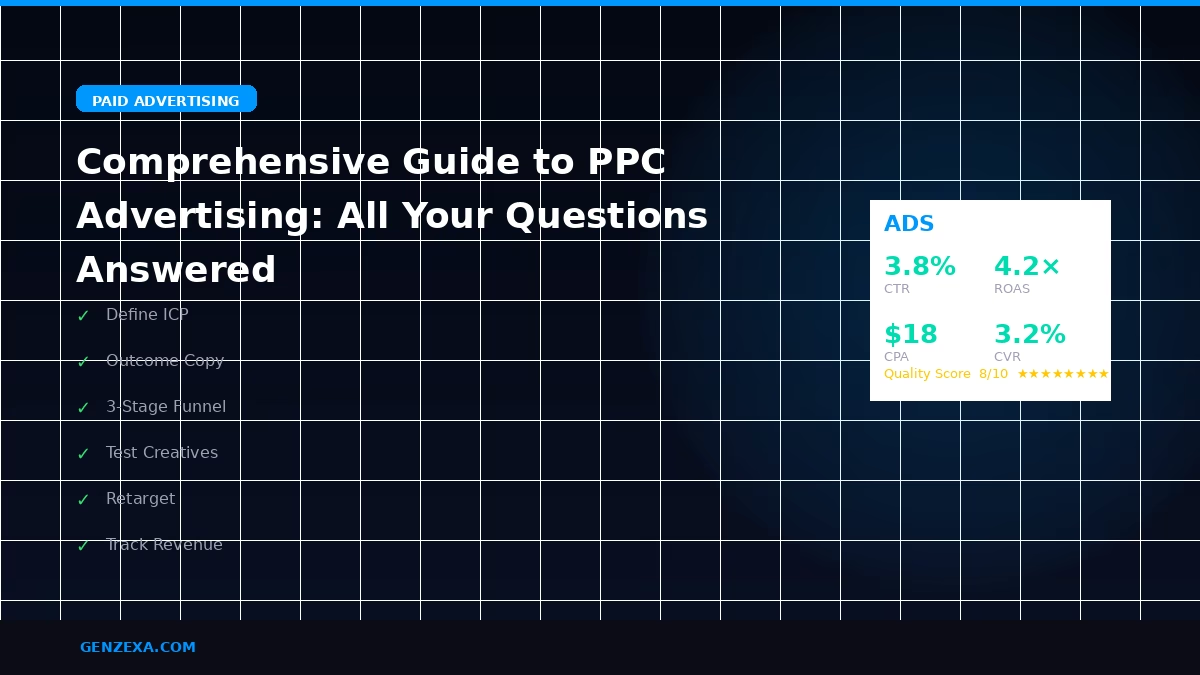
- Quality Score (1–10): Google's rating of how relevant your ad is to the search query. Composed of expected CTR, ad relevance, and landing page experience
- Ad Rank: Bid × Quality Score. A higher Quality Score means you can outrank competitors who are bidding more than you
The practical implication: improving your Quality Score is often more impactful than increasing your bid. A score of 8/10 with a $2 bid beats a score of 4/10 with a $4 bid, and costs you half as much per click.
The PPC Metrics That Actually Matter
There are dozens of metrics available in Google Ads and Meta Ads dashboards. Most of them are noise. These are the ones that actually tell you whether your campaigns are working:
Acquisition Metrics:
- CTR (Click-Through Rate): Clicks ÷ impressions. Measures how compelling your ad is. Industry benchmarks: 2–5% for Google Search, 0.5–1.5% for display
- CPC (Cost Per Click): What you're paying per visitor. Contextualize against conversion rate, a $5 CPC with a 5% conversion rate is cheaper than a $1 CPC with a 0.5% conversion rate
- CPL (Cost Per Lead): Total ad spend ÷ leads generated. The primary metric for lead generation campaigns
Conversion Metrics:
- CVR (Conversion Rate): Conversions ÷ clicks. The most direct measure of how well your landing page is working
- CPA (Cost Per Acquisition): Total spend ÷ customers acquired. The metric that tells you whether acquisition is profitable
- ROAS (Return on Ad Spend): Revenue ÷ ad spend. The ultimate performance metric for eCommerce campaigns. Target: 3–5× minimum for most product categories
Quality Metrics:
- Quality Score: Google's 1–10 rating. Aim for 7+ on all keywords
- Impression Share: How often your ads are shown when they're eligible. Low impression share often indicates a budget or Quality Score problem
The 6 Most Expensive PPC Mistakes (And How to Avoid Them)
Mistake 1: Sending All Traffic to Your Homepage
Your homepage is designed for multiple audiences with multiple intents. A PPC landing page should match the exact message of the ad that delivered the click, same language, same offer, single CTA. Homepage traffic consistently converts at 30–50% lower rates than dedicated landing pages.
Mistake 2: Ignoring Negative Keywords
Without negative keywords, your ads will show for irrelevant searches and you'll pay for clicks that will never convert. Add negative keywords before launch and expand the list weekly as search term data accumulates.
Mistake 3: Setting Campaigns and Forgetting Them
PPC campaigns are not set-and-forget. Search trends shift, competitor bids change, creative fatigue sets in. Weekly optimization reviews are the minimum standard for a managed campaign.
Mistake 4: Not Testing Ad Copy Variations
Run minimum two ad copy variants per ad group at all times. Test headlines, descriptions, and CTAs systematically. The difference between a 2% CTR and a 4% CTR on the same keyword budget halves your effective CPC.
Mistake 5: Ignoring Mobile Performance
In most industries, 55–70% of paid search clicks come from mobile devices. If your campaigns aren't analyzed and optimized by device type, you're missing crucial optimization opportunities.
Mistake 6: Insufficient Budget to Gather Data
PPC requires data to optimize. Campaigns run on $5/day budgets don't accumulate enough click volume to make statistically significant decisions. Under-budgeted campaigns look like they're failing when they're actually just underfunded.
Budget Recommendations by Brand Type
- eCommerce, Google Shopping: $1,500–$3,000/month minimum for meaningful data. Scale based on ROAS benchmarks after 60 days
- eCommerce, Meta Ads: $1,000–$2,000/month for testing phase. Scale once 3 winning creatives are identified
- B2B SaaS, LinkedIn Ads: $3,000–$5,000/month minimum, LinkedIn CPCs are higher but lead quality for B2B is unmatched
- B2B SaaS, Google Search: $2,000–$4,000/month targeting intent-specific long-tail keywords
- Small Business, Local Services: $500–$1,500/month on Google Local campaigns targeting high-intent, location-specific queries
The Three Questions Every PPC Campaign Must Answer Before Launch
- Who exactly is this ad for?, Specific ICP, not "everyone searching for [category]"
- What specific action do we want them to take?, One CTA, not multiple options
- How will we define success?, Specific ROAS, CPL, or CPA target before the first dollar is spent
Answer these three questions before any campaign launches and you'll make better decisions, optimize faster, and waste far less budget on the path to profitable results.
Reading about it is step one. We can do it for you.
Tell us what you sell and what's holding sales back. We'll tell you straight if we're the right people to fix it.
See how our services work →