In this article (6 sections)
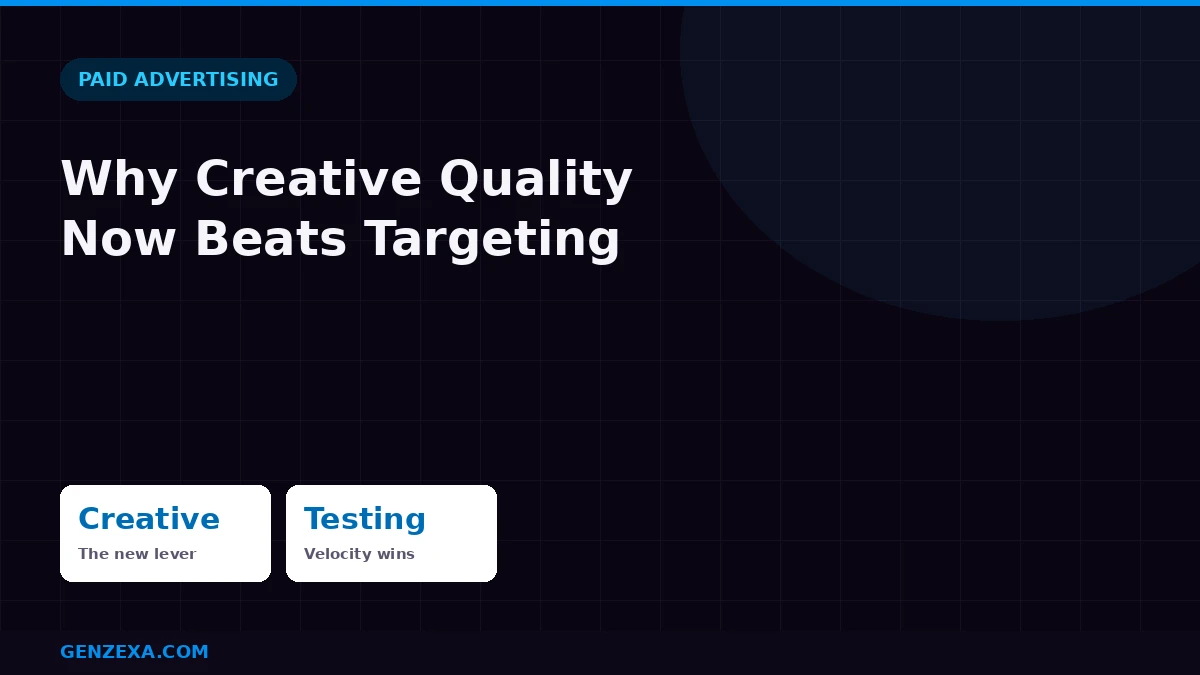
There was a golden era of ad targeting. You could hand-pick an audience so precise it felt like magic, and even average creative would perform because it landed in front of exactly the right person. That era is over. In 2026, targeting precision is eroding, and creative has quietly become the single most important thing that decides whether your ads work.
Why Targeting Got Weaker
Two forces did it. First, privacy regulation keeps tightening the rules on how platforms collect and use data. Second, platforms are giving users more ways to opt out of tracking. The result is that the precise, cookie-fueled targeting brands leaned on for a decade is fading.
At the same time, AI now handles much of the delivery. You're no longer aiming a narrow beam at a tiny audience. You're handing the platform your creative and a goal, and letting it find buyers across a wider net.
Why That Makes Creative King
Here's the logic. If the platform is showing your ad to a broad, AI-selected audience, the ad itself has to do the work of stopping the right people and convincing them. Targeting no longer filters for you. Your creative does.
"When you can't aim as precisely, the ad has to earn attention on its own. That's a creative problem, not a targeting one."
A great creative shown to a broad audience now outperforms a mediocre creative shown to a narrow one. The lever moved. Most brands haven't caught up.
What Great Creative Actually Does Now
- Stops the right person. It speaks so specifically to your buyer that they self-select in the first second, and everyone else scrolls past harmlessly.
- Communicates fast. Attention is shorter than ever. The message has to land almost instantly.
- Feels native, not like an ad. Real, relatable creative outperforms polished ad-looking creative, because people trust it more.
The Real Skill: Testing Velocity
Since creative decides so much, the brands that win are the ones that test the most creative, fastest. It's not about guessing the one perfect ad. It's about running many angles, killing what loses quickly, and scaling what wins. Volume plus fast iteration beats one big bet.
What to Avoid
Don't keep pouring energy into ever-finer targeting while running two tired creatives. That's fighting the last war. And don't confuse polished with effective, expensive production that looks like an ad often loses to honest, native content. The money now goes into creative and testing, not into micro-targeting.
The Bottom Line
The ad game rebalanced. Targeting used to carry weak creative. Now creative has to carry itself, and the brands that build a real creative and testing engine are pulling away from the ones still tweaking audiences. In 2026, creative isn't the pretty part of the ad. It's the strategy.
At GenZexa, building the creative and testing systems that win in this new reality is central to how we run paid ads for the brands we work with.
Related reading: AI-Driven PPC in 2026: How Paid Ads Actually Work Now · Short-Form Video in 2026: How to Make Clips That Sell, Not Just Get Views · Skincare case study: creative testing to 9.10x ROAS
Reading about it is step one. We can do it for you.
Tell us what you sell and what's holding sales back. We'll tell you straight if we're the right people to fix it.
See how our services work →