In this article (8 sections)
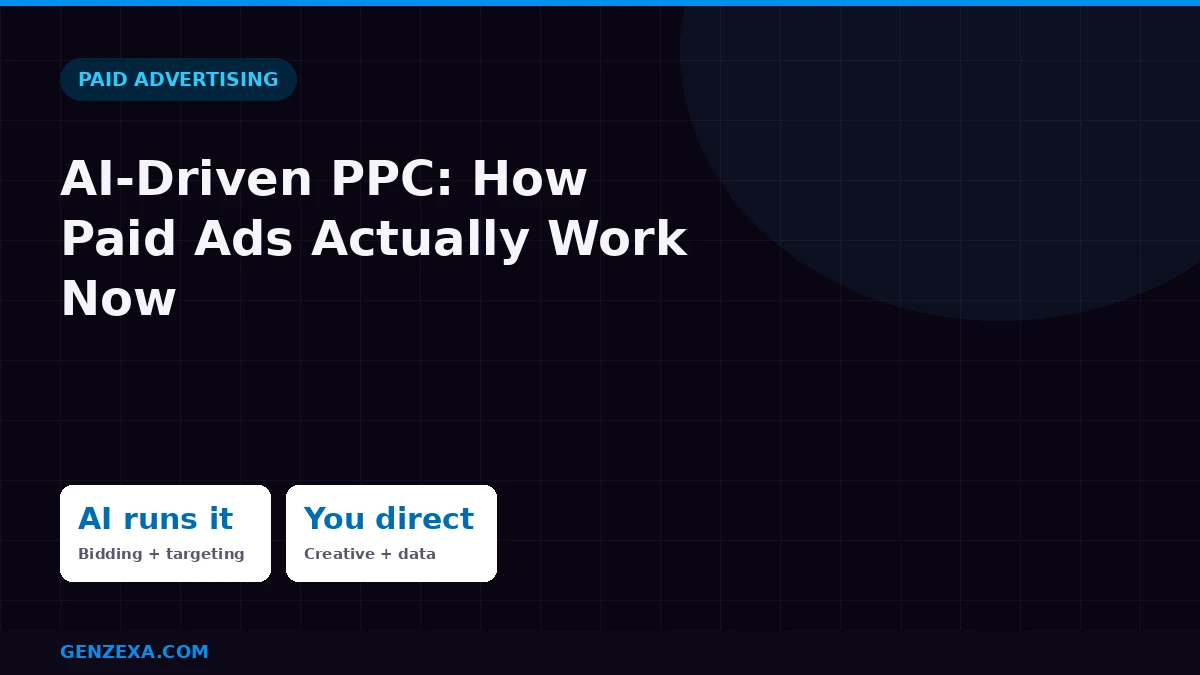
If you haven't run paid ads in a couple of years, you'd barely recognize them. The manual levers marketers used to pull, exact audiences, precise bids, dozens of tweaks, are increasingly handled by AI. In 2026, the machine runs much of the campaign. Your job has shifted from operator to director. Here's what that actually means, and where you still matter most.
What AI Now Handles
- Bidding. AI adjusts your bids in real time, chasing the outcome you set, far faster than any human could.
- Targeting. Instead of you picking narrow audiences, the system finds buyers by learning who converts.
- Copy and combinations. Ad platforms now generate and mix headlines, descriptions, and assets, testing combinations automatically.
- Placements. The system decides where your ad shows, feed, stories, search, video or partner sites, based on where it expects results.
This sounds like it removes your control. It doesn't. It moves your control to a different, more important place.
How It Works on Google and Meta
Google Ads
On Google, the shift started with Smart Bidding, where strategies like Maximize Conversions and Target ROAS let the system set bids for every single auction. Responsive Search Ads took over copywriting decisions: you supply up to 15 headlines and 4 descriptions, and Google tests the combinations. Performance Max goes furthest, running one campaign across Search, YouTube, Display, Discover, Gmail and Maps, with the AI deciding where each impression goes. Broad match keywords, paired with Smart Bidding, now let the system find searches you never thought to target.
Meta Ads
On Facebook and Instagram, Advantage+ campaigns automate audiences, placements and budget distribution. Instead of building detailed interest stacks, you give the system a broad audience, a conversion goal and a set of creatives, and it finds the people most likely to buy. Advantage+ creative options can also adjust images, text and formats for different placements automatically.
The common thread: on both platforms, the inputs you control have shrunk to a few, and each one matters far more than before.
What You Still Control, And Why It's Everything
As targeting gets automated and privacy rules weaken precise audiences, creative quality has become the main lever left. The AI can only work with what you feed it. Give it weak creative and clear goals and it optimizes toward mediocre. Give it strong creative and clean data and it flies.
"When the machine runs the targeting, your creative is the strategy."
The three things that decide your results now:
- Creative quality and volume. More strong variations give the AI more to work with. Testing velocity wins.
- The goal you set. AI optimizes toward whatever you tell it. Point it at purchases and real value, not clicks, or it'll happily buy you cheap clicks that never sell.
- Clean tracking. The AI learns from your conversion data. If that data is wrong, it learns the wrong lesson and wastes budget with confidence.
How to Feed the Machine Properly
1. Give it clean signals
Fix your tracking first. Verified, accurate conversion data is what lets AI optimize toward real sales instead of vanity actions. In practice that means:
- Server-side tracking. Use Meta's Conversions API and Google's enhanced conversions alongside the browser pixel, so purchases still get counted when browsers block cookies.
- No duplicate or missing events. Make sure each purchase is counted once, with the right value, and that add-to-cart and checkout events fire in the right order.
- Real outcomes, not proxies. If your business confirms orders by phone or delivers cash on delivery, feed back the orders that were actually confirmed or delivered, not just form submissions. Otherwise the AI learns to find people who place orders and then cancel.
This is the unglamorous work that decides everything.
2. Feed it strong, varied creative
Produce a steady stream of good creative in different angles and hooks. The system needs options to test. Starve it and it stalls. "Varied" means genuinely different ideas, not the same video with a new colour. Mix formats and angles:
- A problem-and-solution video that opens on the pain your product fixes
- A customer or creator talking to camera about their real experience
- A product demo that shows the result clearly in the first three seconds
- An offer-led static image for warm audiences who already know you
- A comparison that shows why you beat the alternative
3. Set the right objective
Tell the AI to chase actual business outcomes. The wrong goal, set confidently, is how brands lose money faster with automation, not slower. Optimize for purchases or qualified leads, and once you have enough conversion volume, move to value-based bidding so the system chases revenue, not just order count.
4. Give it enough budget and time to learn
AI bidding needs data to learn. Spreading a small budget across many campaigns starves every one of them. Consolidate into fewer campaigns, let each one gather enough conversions, and avoid making big changes every day. Constant edits reset the learning and keep you stuck in an expensive testing phase.
5. Keep humans on the guardrails
Automation is powerful, not perfect. Set brand-safety exclusions, add negative keywords for searches that will never buy, review which placements and search terms are spending money, and check that automatically generated text still sounds like your brand.
A Weekly Routine That Works
- Monday: check tracking health. Do conversions in the ad platforms roughly match real orders in your store?
- Midweek: review creative performance. Which hooks and angles are winning? Brief new variations of the winners.
- Friday: look at the business numbers, cost per purchase, ROAS and profit, not just clicks and reach. Adjust budgets toward what's profitable.
What to Avoid
Don't hand the machine full control and walk away, and don't judge it on the wrong number. AI will optimize hard toward whatever you point it at, so pointing it at clicks or reach instead of profit is an expensive mistake. Don't keep the same three creatives running for months either, because fatigue sets in and costs creep up. Automation amplifies your strategy. If the strategy is wrong, it amplifies the loss.
Quick Answers
Should I still use manual bidding?
For most brands, no. Automated bidding usually outperforms manual bidding once it has enough conversion data. Manual control can still make sense for very small budgets or brand-new accounts with almost no conversion history, as a short starting phase.
Is Performance Max or Advantage+ right for a small brand?
It can be, if your tracking is accurate and you have enough creative to feed it. With broken tracking or one or two tired ads, fully automated campaigns tend to spend quickly on low-quality results. Fix the inputs first, then automate.
How many new creatives should I test?
Enough to keep fresh ideas flowing without spreading budget too thin. For many growing brands that means a few genuinely new concepts every couple of weeks, plus variations of whatever is currently winning. Watch for rising costs and falling click-through rates as signs of creative fatigue.
How much budget does AI bidding need?
The system needs enough conversions each week to learn. If a campaign only gets a handful of sales a week, consolidate campaigns or optimize for an earlier step, such as add-to-cart, until volume builds, then switch to purchases.
Can AI write all my ad copy?
It can draft it quickly, and that's useful for testing more variations. But review everything before it runs. AI copy can drift off-brand, overpromise or sound generic, and in competitive markets the human insight behind a great hook is still what wins.
The Bottom Line
AI-driven PPC isn't set-and-forget. It's set-the-right-things-and-feed-it-well. The operators winning in 2026 stopped pulling small levers and started focusing on the two things that now decide everything: creative and clean data. That's where the human edge lives now.
At GenZexa, running paid ads the way they actually work in 2026, clean tracking, strong creative, right objectives, is exactly what we do for the brands we work with. You can see what that looks like in practice in our skincare case study, where cleaning up tracking and testing creative took ROAS from under 1.7x to 9.10x.
Reading about it is step one. We can do it for you.
Tell us what you sell and what's holding sales back. We'll tell you straight if we're the right people to fix it.
See how our services work →