In this article (4 sections)
Small businesses don't lose to larger competitors because of budget. They lose because they spread that smaller budget across tactics that don't work, in channels that don't fit, without the systems to make any of it compound. This guide is about using your resources more intelligently, getting maximum return from every dollar and every hour you invest in marketing.
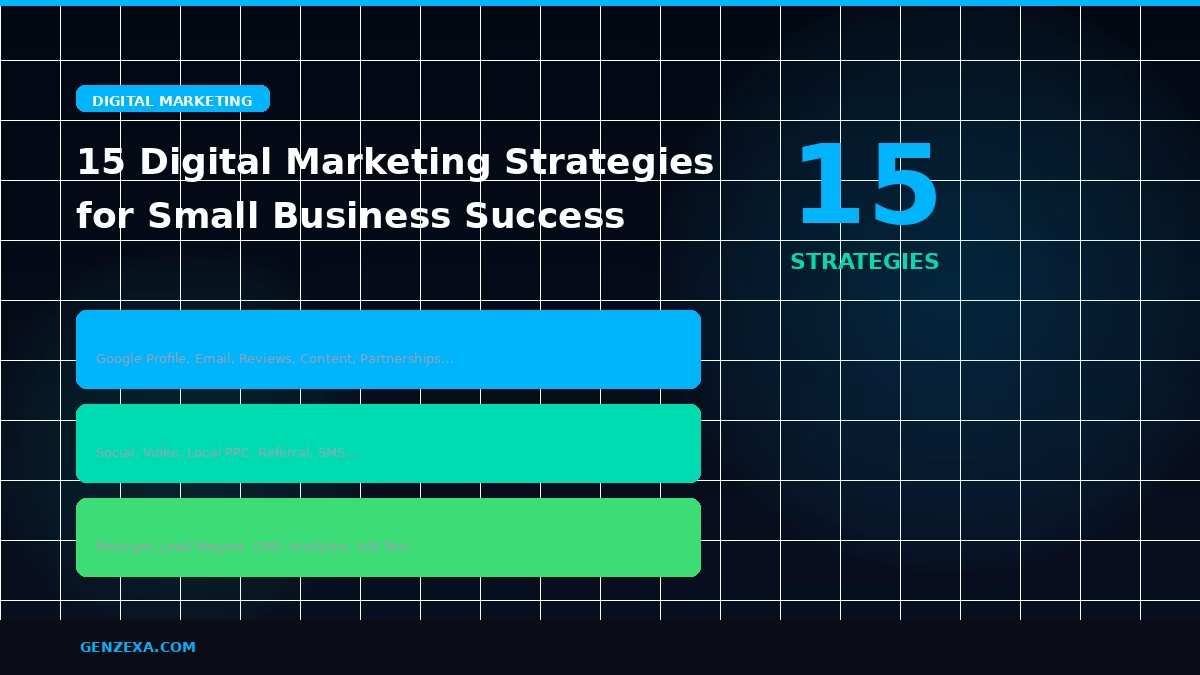
These 15 strategies are ranked roughly by cost-to-impact ratio. Start at the top. Build momentum. Then expand.
The Free and Near-Free Foundation (Strategies 1–5)
1. Claim and Fully Optimize Your Google Business Profile
For local businesses, a complete and actively managed Google Business Profile is often the highest-ROI marketing investment available, and it's free. Complete every field, add photos weekly, post updates regularly, and respond to every review. Businesses with complete profiles get 7× more clicks than incomplete ones.
2. Build an Email List Starting Today
Even 500 engaged email subscribers is a genuinely valuable business asset. Add a sign-up form to your website. Offer a compelling reason to subscribe, a discount, a useful resource, early access. Send at least one useful email per week. An owned audience is the only audience that can't be taken away by an algorithm change.
3. Ask for Reviews Systematically
Reviews are social proof that converts browsers into buyers, and they cost nothing to collect. Build a simple, consistent process: after every positive customer interaction, send a direct link to your Google or Yelp review page. 70% of customers will leave a review if asked directly and given an easy path. A 4.8-star average with 50+ reviews is a significant conversion asset.
4. Publish Content That Answers Your Customers' Actual Questions
What questions do your customers ask before buying? What problems are they searching for solutions to? Create content, blog posts, FAQ pages, YouTube videos, that answers those questions honestly and specifically. This builds trust, improves search visibility, and positions your brand as the most knowledgeable option in your category.
5. Partner With Complementary Local Businesses
Cross-promotion costs nothing and can deliver substantial reach. Identify businesses that serve the same customer base you do without competing directly. Agree to promote each other, social posts, email mentions, physical referrals. One well-matched partnership can generate more new customers than months of solo marketing.
The Low-Cost Acquisition Strategies (Strategies 6–10)
6. Choose One Social Media Platform and Own It
Small businesses that try to maintain a presence on every platform are mediocre everywhere and excellent nowhere. Choose the single platform where your customers spend the most time. Post consistently. Engage genuinely. Build depth before breadth. A strong following on one platform is more valuable than a weak one on five.
7. Create Short-Form Video Content
Short-form video on TikTok, Instagram Reels, and YouTube Shorts currently reaches organic audiences at a scale and cost that no other format can match. Behind-the-scenes content, customer results, quick educational tips, and honest brand story content perform well for small businesses because authenticity is a competitive advantage over polished corporate content.
8. Run Google Local Campaigns
Google Local Ads target people actively searching for businesses like yours in your specific geographic area. High purchase intent, immediate location targeting, and measurable results make this one of the best paid acquisition channels for service-based local businesses. Start with $300–$500/month and scale based on ROI.
9. Build a Simple Referral Program
Give your happiest customers a reason to tell their friends. A referral program doesn't need to be sophisticated, a simple discount for both the referrer and the new customer, communicated clearly at the peak of satisfaction, is enough. Referral customers cost far less to acquire and stay longer than paid-channel customers.
10. Use WhatsApp or SMS for High-Priority Follow-Ups
SMS open rates are 90%+, compared to 20–25% for email. For appointment reminders, booking confirmations, follow-up after service delivery, and time-sensitive offers, SMS delivers messages that actually get read. Keep it personal, infrequent, and valuable, this channel is powerful precisely because it's intimate, and it dies the moment it feels spammy.
The Scale and Optimize Strategies (Strategies 11–15)
11. Add Retargeting to Your Paid Campaigns
Even on a small budget, retargeting delivers exceptional returns because the audience is already warm. A $5–$10/day retargeting campaign that shows your offer to recent website visitors will consistently generate better ROAS than the same budget spent on cold traffic. Set it up once. Let it run permanently.
12. Build a Lead Magnet
A lead magnet is something genuinely valuable you offer for free in exchange for an email address. For service businesses: a free consultation checklist, buying guide, or how-to guide. For product businesses: a discount, a free sample, or a style guide. The key is that it must solve a real problem for your specific ICP, not just feel like a bribe.
13. Optimize Your Website for Conversion (Not Just Traffic)
Most small business websites are designed to inform rather than convert. Adding a clear value proposition above the fold, a prominent CTA on every page, genuine customer testimonials, and a simplified contact or purchase flow can double conversion rates without changing your traffic at all. Start with the page that gets the most traffic and fix it first.
14. Track Everything in Google Analytics 4
You cannot improve what you're not measuring. Google Analytics 4 is free, powerful, and gives you the data you need to understand where traffic comes from, what content people engage with, and where customers drop off before converting. An hour spent setting up proper tracking will return hundreds of hours of better decision-making.
15. Test One Variable at a Time
The biggest mistake small businesses make when trying to improve marketing performance is changing multiple things simultaneously. When results improve or decline, there's no way to know what caused it. Pick one variable, a headline, a CTA, an offer, a targeting change, test it against the current version, measure the result, decide, and move to the next test. This simple discipline compounds into dramatically better performance over 6–12 months.
Where to Start
If you're beginning from scratch, start with strategies 1, 2, and 3. They're free, high-impact, and build the foundation everything else relies on. Add one new strategy every 30–60 days as each previous one becomes a sustainable habit. Slow, systematic building consistently outperforms trying to implement everything at once.
Reading about it is step one. We can do it for you.
Tell us what you sell and what's holding sales back. We'll tell you straight if we're the right people to fix it.
See how our services work →