In this article (5 sections)
Digital marketing is one of the most misunderstood investments a business can make. Brands pour money into ads, hire content creators, maintain social media accounts, and still see their revenue plateau. The frustration is real. But the problem is almost never what they think it is.
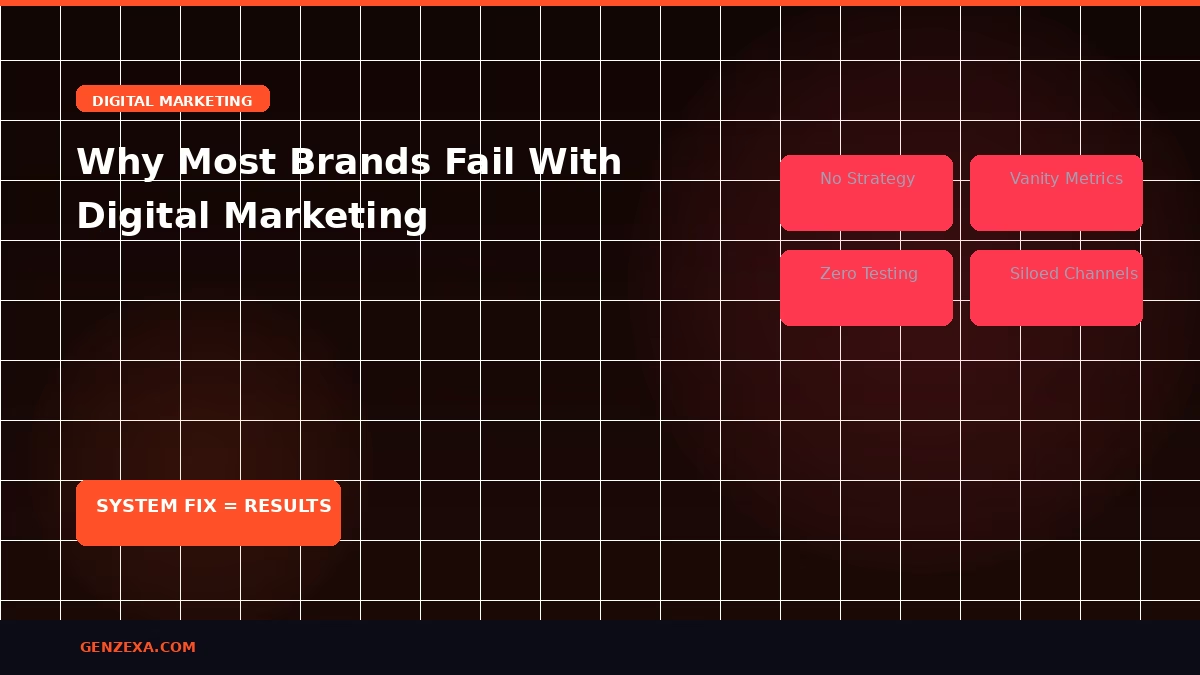
It's not the budget. It's not the platform. It's not even the product. It's the absence of a connected strategy. Here are the four reasons most brands fail at digital marketing, and exactly how GenZexa addresses each one.
Reason 1: No Clear, Documented Strategy
What this looks like:
Posting content whenever someone has time. Boosting ads when sales feel slow. Trying TikTok because a competitor is on it. Making decisions based on trend rather than intent. This isn't marketing, it's noise generation.
Why it fails:
Without a documented plan that connects each channel to a specific audience, funnel stage, and measurable outcome, every marketing action is disconnected from every other. Nothing reinforces anything else. Spend accumulates without compounding.
How GenZexa fixes it:
Every engagement starts with a full channel-by-channel strategy document: who are we targeting at each funnel stage, what message do they need, on which platform, at what frequency, measured against which KPI. Strategy first. Execution second. Always.
Reason 2: Chasing Vanity Metrics Instead of Revenue Metrics
What this looks like:
Weekly reports full of follower counts, impressions, and likes. Celebrating a post that "went viral" while sales remain flat. Measuring reach as a proxy for business results.
Why it fails:
Vanity metrics feel good and mean nothing. Impressions don't pay salaries. Followers don't buy products. If you can't draw a direct line from a metric to revenue, that metric is not a KPI, it's a distraction.
How GenZexa fixes it:
We replace vanity dashboards with revenue dashboards. The metrics we track: CAC, ROAS, CPL, CVR, LTV, and repeat purchase rate. Every campaign is evaluated against its contribution to actual revenue. If it can't be measured in dollars, it's optimized until it can be.
Reason 3: Zero Testing Culture
What this looks like:
One ad creative running for three months. One email subject line format used across every campaign. No hypothesis, no variants, no learnings. "We tried it and it didn't work", based on a single execution of a single idea.
Why it fails:
Marketing performance is discovered, not assumed. The best-performing headline, creative, offer, and CTA for your audience is never obvious upfront. It has to be tested, measured, and iterated. Brands that don't test get stuck at the performance level of their first attempt.
How GenZexa fixes it:
We install a systematic testing culture from day one: minimum three creative variants per campaign, A/B tested subject lines for every email sequence, monthly landing page optimization cycles. Every test generates a learning. Every learning improves the next execution.
Reason 4: Treating Marketing Channels as Separate Silos
What this looks like:
An email team that doesn't know what the ads team is running. Social media content that contradicts the messaging on the website. SEO articles that aren't connected to any paid campaign. A retargeting strategy built without reference to the email nurture flow.
Why it fails:
Marketing works through repetition and reinforcement. A prospect who sees your ad, then receives a follow-up email with the same message, then gets retargeted on Instagram, converts at dramatically higher rates than a prospect who only sees one of those touchpoints. Siloed channels can't create this effect. Connected systems can.
How GenZexa fixes it:
We architect marketing systems where every channel supports every other channel. Paid ads drive email sign-ups. Email nurtures drive retargeting audiences. SEO content reinforces paid ad messaging. Each piece is designed to amplify the others, creating a compounding system instead of a collection of disconnected tactics.
The GenZexa Diagnostic: Where to Start
Every new client engagement begins with the same process: a full marketing audit designed to find the revenue leaks before we build anything new.
What the audit covers:
- Current channel performance against revenue benchmarks
- Funnel mapping, where are prospects dropping off?
- Creative and messaging audit, what's working and what's not?
- Attribution analysis, which channels are actually driving revenue?
- Competitive landscape, what are high-performing brands in the space doing differently?
In most cases, the biggest revenue opportunity isn't in adding new channels, it's in fixing what's already broken. The brands that fix the foundation first always scale faster than the brands that keep building on top of cracks.
You don't have a marketing problem. You have a system problem. Fix the system and the marketing works.
Reading about it is step one. We can do it for you.
Tell us what you sell and what's holding sales back. We'll tell you straight if we're the right people to fix it.
See how our services work →