In this article (6 sections)
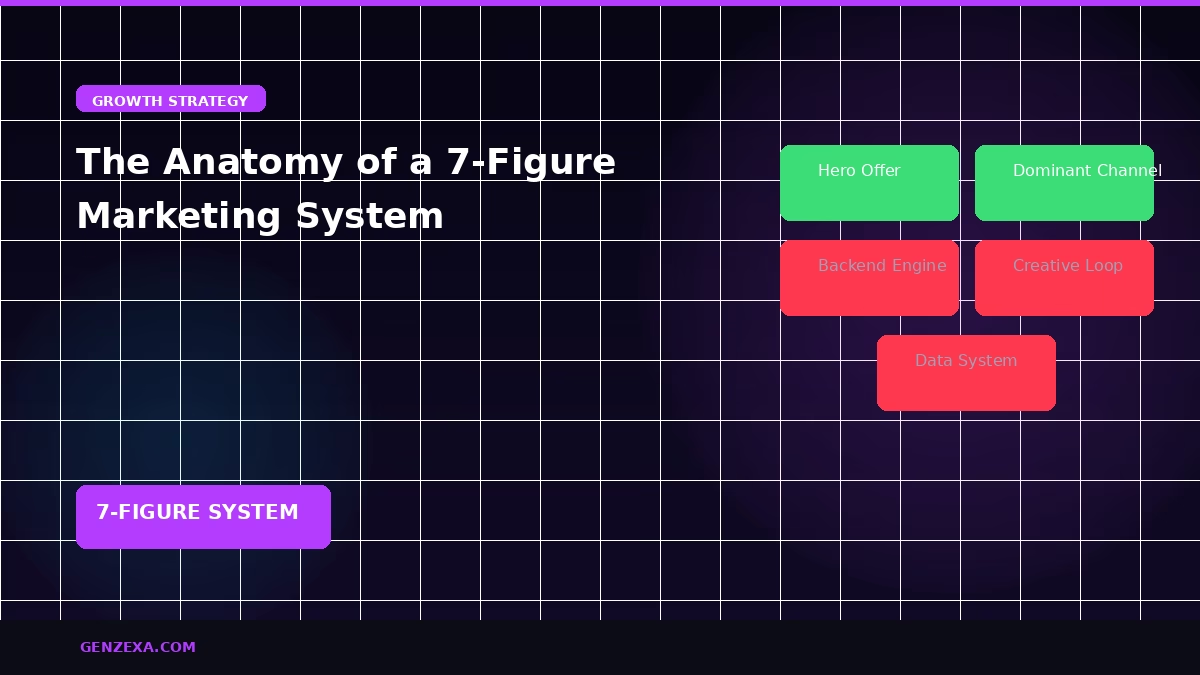
- Component 1: A Single, Clear Hero Offer
- Component 2: A Predictable, Dominant Acquisition Channel
- Component 3: A Backend Revenue Engine (The Most Commonly Missing System)
- Component 4: A Creative Testing Loop (The Second Most Commonly Missing System)
- Component 5: A Data Feedback System
- The Three Systems 90% of Brands Are Missing
After auditing over 70 eCommerce brands, SaaS startups, and service businesses, one pattern appears without exception: brands don't fail because they lack traffic. They fail because they lack a system.
They have website visitors but no conversion strategy. They have buyers but no retention plan. They have marketing spend but no testing framework. Each piece exists in isolation, and nothing compounds. Here are the five components that every 7-figure marketing system has, and the three that 90% of brands are completely missing.
Component 1: A Single, Clear Hero Offer
What most brands do:
Promote 12 products with equal priority, scattered messaging across five channels, and marketing that tries to appeal to every possible customer simultaneously. The result: no one feels like the messaging is for them.
What 7-figure brands do:
Identify one flagship offer that solves the most painful problem for the most valuable customer segment, and point all marketing at it. Every ad, every email, every piece of content serves the same purpose: drive interest in the hero offer.
Clarity converts. Confusion kills. One offer done well will always outperform twelve offers done poorly.
Component 2: A Predictable, Dominant Acquisition Channel
What most brands do:
Spread budget thin across five channels, Facebook, TikTok, Google, LinkedIn, email, mastering none of them. Results are mediocre everywhere because expertise is divided everywhere.
What 7-figure brands do:
Identify the single channel where their ICP is most concentrated and most acquirable, and become the best in their category on that channel before diversifying. Master one channel. Own it completely. Then expand from a position of strength rather than spreading from a position of weakness.
How to identify your dominant acquisition channel:
- Where do your best existing customers come from?
- Where does your ICP spend the most time and have the highest purchase intent?
- Where can you produce consistently strong creative at scale?
Component 3: A Backend Revenue Engine (The Most Commonly Missing System)
What most brands do:
Treat the first sale as the end of the customer relationship. No email flows. No upsell sequences. No loyalty program. No win-back campaigns. Revenue is entirely dependent on constantly acquiring new customers.
What 7-figure brands do:
Build a complete backend revenue infrastructure where existing customers generate 35–45% of monthly revenue automatically. Email sequences, SMS campaigns, loyalty mechanics, and repeat-purchase incentives run permanently, generating revenue that costs almost nothing to produce.
- Welcome flow → converts new subscribers into first-time buyers
- Post-purchase sequence → converts one-time buyers into repeat customers
- Win-back campaign → reactivates lapsed customers before they're lost forever
- VIP program → maximizes LTV from your most valuable customer segment
This is the system that takes a brand from 3× blended ROAS to 6×. Same acquisition spend. Dramatically higher revenue per customer.
Component 4: A Creative Testing Loop (The Second Most Commonly Missing System)
What most brands do:
Launch one ad creative. Run it for three months. Wonder why performance declines. Replace it with one new creative. Repeat. Never test more than one variable at a time. Never build institutional knowledge about what resonates with their audience.
What 7-figure brands do:
Run a permanent creative testing engine. New creative variants launch every 2–3 weeks. Performance data is reviewed weekly. Winners scale immediately. Losers cut immediately. Institutional knowledge about what works accumulates over time and makes every future campaign better than the last.
The creative testing framework:
- Minimum 3 variants per campaign at launch
- Test one variable at a time: hook, visual, CTA, or offer
- Decision made at Day 7 based on CPL and CTR data
- Winner becomes the new control. New challengers launched immediately
Component 5: A Data Feedback System
What most brands do:
Check overall revenue numbers and ad platform dashboards. Make decisions based on gut feel or recent anecdotal evidence. React to problems after they become expensive rather than preventing them with early data signals.
What 7-figure brands do:
Run a structured weekly data review with clearly defined KPIs at every stage of the funnel. Decisions are made against data benchmarks, not feelings. Every change is documented and measured against a hypothesis. The system learns from every campaign and applies those learnings automatically to the next one.
The minimum weekly metrics review:
- CAC vs. LTV ratio, is acquisition profitable?
- ROAS by channel and creative, where is money working hardest?
- Conversion rate by funnel stage, where is the biggest leak?
- Repeat purchase rate, is retention growing?
- Email revenue percentage, is the backend working?
The Three Systems 90% of Brands Are Missing
Of these five components, brands consistently have 1 and 2 in some form. The missing three, the backend revenue engine, the creative testing loop, and the data feedback system, are the exact gaps that keep brands stuck below 7 figures despite consistent marketing investment.
Build all five. Run them simultaneously. Let them compound. That's what a 7-figure marketing system actually looks like.
Reading about it is step one. We can do it for you.
Tell us what you sell and what's holding sales back. We'll tell you straight if we're the right people to fix it.
See how our services work →
First-Party Data in 2026: Why Owning Your Customer Data Is Now a Competitive Edge
6 min read
Hyper-Personalization in 2026: Why Retention Is the Real Growth Engine
7 min read