In this article (8 sections)
- Strategy 1: Content Marketing, Build Trust Before the Sale
- Strategy 2: Email Marketing, Own Your Audience
- Strategy 3: Paid Social Advertising, Scalable Acquisition
- Strategy 4: Search Engine Optimization, Compounding Organic Revenue
- Strategy 5: Retargeting, The Highest-ROAS Channel You Might Be Ignoring
- Strategy 6: Referral Marketing, The Lowest-CAC Acquisition Channel
- Strategy 7: Conversion Rate Optimization, More Revenue From Existing Traffic
- The System That Multiplies Everything
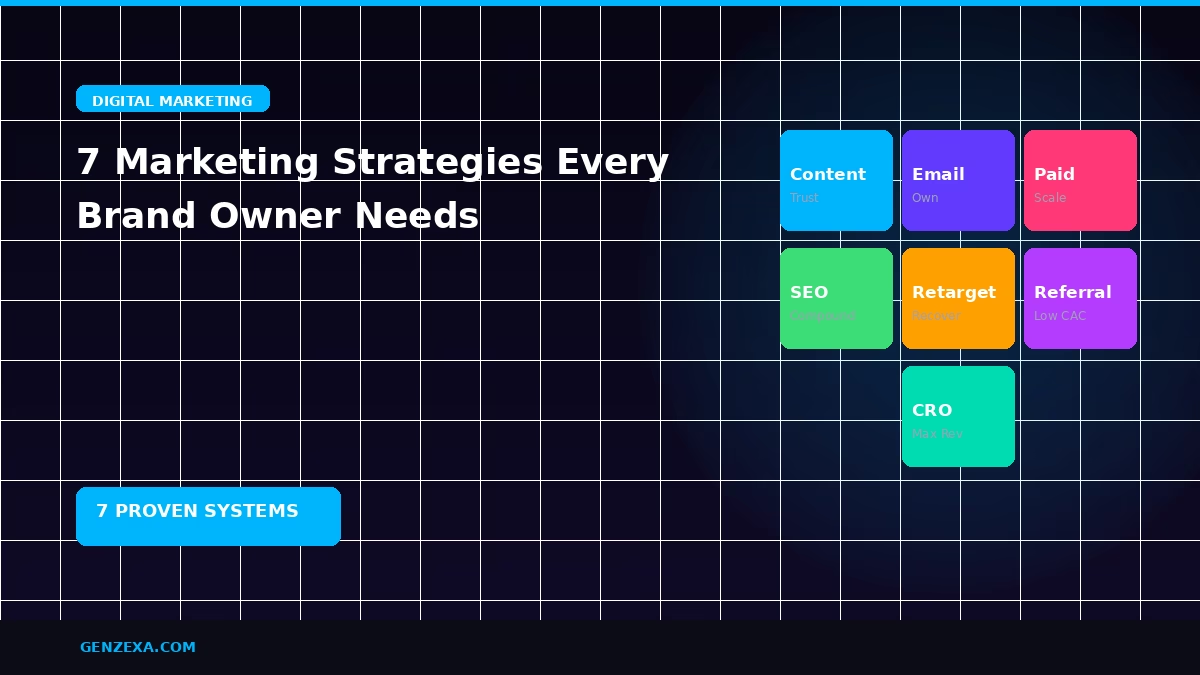
There are hundreds of marketing tactics available to any brand today. Most of them are distractions. The brands that scale consistently aren't trying everything, they're executing a handful of proven strategies with real discipline and depth. Here are the seven that move the needle for virtually every growing brand, and how to make them work together as a compounding system.
Strategy 1: Content Marketing, Build Trust Before the Sale
Content marketing is the long game that most brands underinvest in because the returns aren't immediate, and the game-changing advantage that the brands willing to play it long-term almost always build.
What effective content marketing looks like today:
- Blog content that ranks for buyer-intent keywords (not just informational keywords)
- Short-form video that educates your audience while building brand familiarity
- In-depth guides that establish genuine expertise in your category
- Repurposing: one piece of core content adapted into multiple formats for multiple platforms
The compounding effect: content published today generates traffic, trust, and leads indefinitely. Unlike paid advertising, the return continues long after the production cost is forgotten.
Strategy 2: Email Marketing, Own Your Audience
Your email list is the only audience you truly own. Social followers can disappear with an algorithm change. Ad audiences exist at the discretion of the platform. But an email list is yours, permanently, unconditionally, and at zero marginal cost to reach.
The email sequences that generate the most revenue:
- Welcome sequence: First impression. Brand story, core value proposition, best social proof, first-purchase offer
- Abandoned cart sequence: Recover 10–20% of revenue that would otherwise be lost
- Post-purchase sequence: Convert one-time buyers into repeat customers with strategic follow-up value
- Re-engagement sequence: Win back lapsed subscribers before they disengage permanently
Email consistently delivers the highest ROI of any digital marketing channel, build and nurture your list aggressively at every stage of growth.
Strategy 3: Paid Social Advertising, Scalable Acquisition
Paid social, primarily Meta (Facebook + Instagram) and TikTok, remains the most scalable acquisition channel for consumer brands and B2C SaaS. The key is understanding that paid social requires a testing infrastructure, not just a budget.
The paid social system that works:
- Creative-first approach: allocate 20% of ad budget to creative testing
- Separate TOF (cold) and BOF (warm) campaigns with distinct messaging
- 7–14 day test cycles before making scaling decisions
- Mandatory retargeting layer running in parallel with cold acquisition
Strategy 4: Search Engine Optimization, Compounding Organic Revenue
SEO takes 3–6 months to show results. This is why most brands underinvest in it. This is also why the brands that do invest in it systematically build a compounding competitive advantage that competitors can't quickly replicate.
The three SEO priorities that drive revenue (not just traffic):
- Buyer-intent keyword targeting: Rank for terms searched by people who are ready to buy, not just people who are curious
- Technical SEO foundation: Site speed, mobile optimization, crawlability, the baseline that determines whether your content can rank at all
- Authority building: Backlinks from relevant, authoritative sources that signal credibility to search engines
Strategy 5: Retargeting, The Highest-ROAS Channel You Might Be Ignoring
Retargeting reaches people who already know about your brand and have shown genuine interest, they visited your site, viewed a product, engaged with your social content, or opened your emails. These are the warmest prospects in your entire marketing universe, and they convert at dramatically higher rates than cold audiences.
The essential retargeting audiences for any brand:
- Website visitors in the last 30 days (segmented by pages visited)
- Cart abandoners in the last 7 days (highest urgency)
- Email subscribers who haven't purchased in 60+ days
- Social media engagers from the last 30–60 days
- Past purchasers (for repeat purchase and upsell campaigns)
Strategy 6: Referral Marketing, The Lowest-CAC Acquisition Channel
Word-of-mouth marketing has always had the lowest cost-per-acquisition of any acquisition channel. Referral marketing systematizes word-of-mouth, it gives your happy customers a reason, a mechanism, and a reward for sharing your brand with their network.
Referral program design principles:
- The reward must feel genuinely valuable to both referrer and referee
- The sharing mechanism must be frictionless, one link, easy to share
- The trigger should happen at the peak of customer satisfaction (immediately post-purchase or at first meaningful use)
- Track referral revenue separately to measure true CAC from this channel
Referral-acquired customers typically have higher LTV and lower churn than customers acquired through paid channels, because they came in with a built-in social endorsement from someone they trust.
Strategy 7: Conversion Rate Optimization, More Revenue From Existing Traffic
Of the seven strategies in this guide, CRO is the one most brands completely ignore, and the one with the highest short-term ROI. A 1% improvement in your website's conversion rate is equivalent to a 50% increase in your ad budget in terms of revenue impact.
The CRO improvements with the highest impact:
- Hero section headline testing, what value proposition statement converts best?
- CTA placement and copy optimization
- Social proof positioning, where above the fold drives the most trust?
- Checkout flow simplification, every unnecessary field is a conversion leak
- Mobile experience optimization, because 70%+ of your traffic is on mobile
The System That Multiplies Everything
None of these seven strategies works in isolation as effectively as all seven working together. Content attracts organic traffic into email. Email nurtures into purchase. Paid social scales acquisition. SEO compounds over time. Retargeting recovers what would otherwise be lost. Referrals multiply acquisition efficiency. CRO makes everything else more profitable. Build the system, not just the tactics.
Reading about it is step one. We can do it for you.
Tell us what you sell and what's holding sales back. We'll tell you straight if we're the right people to fix it.
See how our services work →