In this article (9 sections)
- The Starting Point: Good Product, Broken System
- Phase 1: Identify the Right Audience
- Phase 2: Rebuild the Website for Conversion
- Phase 3: Build a Winning Paid Ads Strategy
- Phase 4: Install the Retargeting Funnel
- Phase 5: Influencer and Social Proof Strategy
- Phase 6: Continuous Data Optimization
- Final Results: Month 6 vs. Month 1
- What Made the Difference
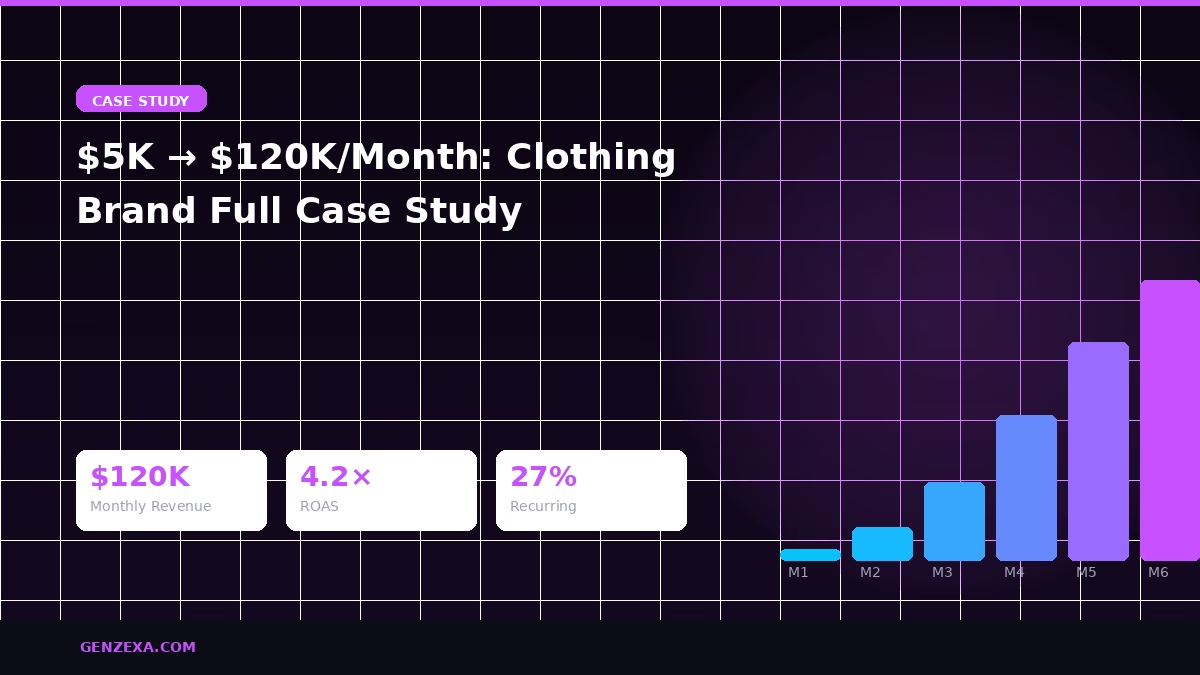
Theory is easy. Results are what matter. This is a real case study of a real clothing brand, and a step-by-step breakdown of exactly how GenZexa helped them go from $5,000/month in online revenue to $120,000/month in under six months.
This is one of several clothing brands we have helped grow, each with its own starting point. For a different label's six-month turnaround from $15,000 to $210,000 a month, read this clothing brand transformation, or see our apparel case study.
No shortcuts. No luck. Just a repeatable, full-funnel system applied with precision.
The Starting Point: Good Product, Broken System
When this brand first approached GenZexa, the product was genuinely good. The problem wasn't what they were selling, it was everything around it.
The diagnosis before we touched anything:
- Monthly revenue: $5,000 and stagnant
- Website conversion rate: 0.8% (industry average is 2–3%)
- ROAS: 1.3× (effectively losing money on every ad dollar)
- Email infrastructure: zero, no flows, no list, no automation
- Retargeting: none whatsoever
- Ad creative: a single video running to broad audiences with no testing
The opportunity was obvious. And so was the roadmap.
Phase 1: Identify the Right Audience
Before touching a single ad or rewriting a single headline, we rebuilt the audience strategy from scratch.
What we defined in week one:
- Demographics: Age range, gender split, income bracket, and geographic concentration
- Psychographics: Values, lifestyle, aesthetic preferences, social media behavior
- Pain points: What were previous purchases disappointing them on? Quality? Fit? Style?
- Buying behavior: Device usage, preferred platforms, average order timing
This audience intelligence shaped every creative, every email, and every ad targeting decision going forward. Audience first. Everything else second.
Phase 2: Rebuild the Website for Conversion
A beautiful website that doesn't convert is just an expensive brochure. The brand's old site had great photography and a terrible user experience. We fixed that.
CRO improvements made in the first two weeks:
- Simplified site navigation, reduced from 11 menu items to 5
- Rewrote product descriptions from feature lists to benefit narratives
- Added size guides, lifestyle imagery, and UGC to every product page
- Placed customer reviews and star ratings above the fold on key pages
- Implemented one-click checkout and multiple payment options
- Redesigned mobile experience completely, 74% of their traffic was mobile
Result in month one: Website conversion rate jumped from 0.8% to 2.6%, a 225% improvement without changing a single ad.
Phase 3: Build a Winning Paid Ads Strategy
With the website finally converting, we had a funnel worth sending traffic to. Now we scaled acquisition intelligently.
Facebook and Instagram Ad Strategy:
- Launched 7 creative variations across carousel, video, and story formats
- Ran separate TOF (cold audience) and BOF (retargeting) campaigns with distinct messaging
- A/B tested hook copy, "lifestyle-led" vs. "problem-led" vs. "social proof-led"
- Scaled winning creatives from $50/day to $400/day after 14-day performance data
Google Ads Strategy:
- Google Shopping campaigns for brand and category keywords
- Search ads targeting competitor brand names and high-intent purchase queries
- Display retargeting for all site visitors who didn't convert
Result at day 45: ROAS improved from 1.3× to 4.2×. Ad spend was generating profitable returns for the first time in the brand's history.
Phase 4: Install the Retargeting Funnel
Most of the brand's lost revenue was sitting in one place: people who visited but didn't buy. We built a complete retargeting ecosystem to recapture it.
Retargeting layers we built:
- Email sequences: 3-part cart abandonment (1hr → 24hr → 72hr), post-purchase upsell, and win-back flow
- SMS campaigns: Flash sale announcements and personalized "we noticed you left this" messages
- Dynamic social ads: Facebook and Instagram ads showing the exact products each user had viewed
Retargeting became the brand's highest-ROAS channel within 30 days of launch, generating 31% of total revenue at a fraction of the cost of cold acquisition.
Phase 5: Influencer and Social Proof Strategy
Paid ads drive volume. Social proof drives conversion. We combined both by building a systematic influencer program focused on micro-creators with genuine niche authority.
What the influencer strategy included:
- 20 micro-influencer partnerships (10K–80K followers each) in relevant style niches
- Product gifting with full UGC rights, content used directly in paid ads
- Performance-based affiliate codes to track and reward genuine conversions
- Reposting top-performing UGC across the brand's own social channels
Result: Organic traffic increased 42%. UGC content outperformed brand-produced creative in 7 out of 10 A/B tests, at zero production cost.
Phase 6: Continuous Data Optimization
The final layer is the one most brands skip: relentless, data-driven optimization week after week. Every metric told a story. We listened to every one of them.
What we tracked and optimized weekly:
- CTR per ad creative, killing underperformers, scaling winners
- Conversion rate by traffic source, identifying which channels delivered real buyers
- CAC vs. LTV, ensuring profitability at the customer level, not just the campaign level
- Top-selling products, shifting budget toward highest-margin, best-converting SKUs
- Email performance, open rates, click rates, and revenue per email
Final Results: Month 6 vs. Month 1
- Monthly revenue: $5,000 → $120,000
- Website conversion rate: 0.8% → 2.6%
- ROAS: 1.3× → 4.2×
- Recurring revenue from retention: 0% → 27% of total monthly revenue
- Email list: 400 subscribers → 18,000 active subscribers
- Organic traffic: Up 42%
What Made the Difference
Not one single tactic. Not one lucky ad. A complete system where audience intelligence informed creative, creative drove traffic, traffic landed on a high-converting website, and a retention engine kept buyers coming back.
This is replicable. The principles don't change. The execution is specific to each brand, but the framework scales across any eCommerce business willing to apply it with discipline.
Reading about it is step one. We can do it for you.
Tell us what you sell and what's holding sales back. We'll tell you straight if we're the right people to fix it.
See all our case studies →