In this article (4 sections)
Neuroscience has confirmed what marketers have known intuitively for decades: stories are the most powerful persuasion technology ever invented. When you encounter a story, your brain releases oxytocin, the trust hormone, and your neural activity synchronizes with the storyteller's. You don't just understand the narrative. You experience it. And that experience drives decisions in a way that bullet points and feature lists never will.
In an era of infinite content and shrinking attention spans, the brands that convert most consistently aren't the ones with the biggest budgets. They're the ones that make their audience feel something. Here's how to build that capability deliberately.
Why Stories Work When Facts Don't
Consider the difference between these two approaches to the same product:
- Facts: "Our supplement contains 500mg of Vitamin B12, 400mg of Magnesium, and a proprietary blend of adaptogenic herbs clinically shown to reduce cortisol levels by 23%."
- Story: "Three months ago, Sarah was waking up already exhausted, hitting snooze four times and starting every day behind. She tried everything. Then she changed one thing before bed. Now she wakes up before her alarm."
The first triggers analytical thinking: "Is this good value? Are these ingredients scientifically valid? How does this compare to alternatives?" The second triggers emotional identification: "That's me. I want to be where Sarah is." Emotional identification closes far more sales than analytical evaluation.
Facts create knowledge. Stories create conviction. Conviction drives purchase.
The Four-Part Storytelling Framework for Marketing
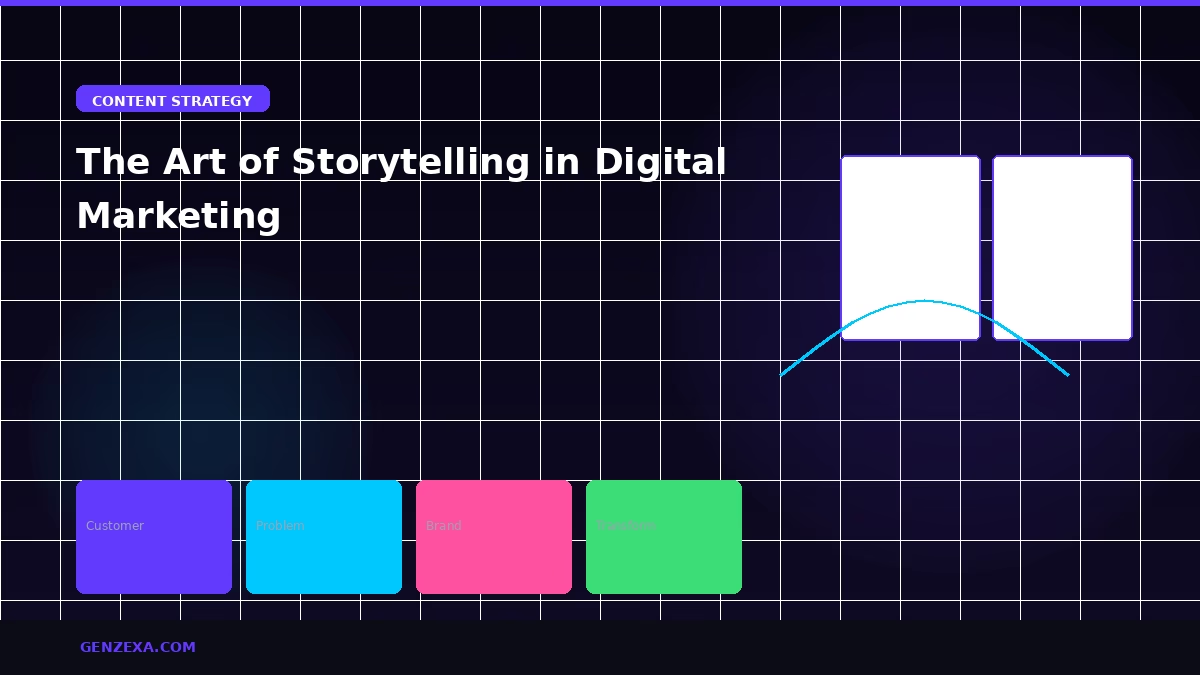
The most effective marketing stories follow the same narrative structure that's driven human storytelling for thousands of years, adapted for conversion:
Part 1: The Character (Your Customer as the Hero)
Every compelling story has a protagonist the audience can identify with. In marketing, that protagonist is your customer, not your brand. The moment you make your brand the hero, you lose your audience's emotional investment.
The character should be described in enough specific detail that your exact ICP thinks: "That's me." Generic characters generate generic responses. Specific characters generate identification.
What makes a strong marketing character:
- Specific, relatable situation (not "a busy professional" but "a founder managing a team of eight")
- A clear desire or aspiration that the audience shares
- A specific obstacle standing between them and that desire
- Language that mirrors exactly how your real customers describe themselves
Part 2: The Conflict (The Problem Worth Solving)
Stories without conflict are boring. Marketing without conflict is forgettable. The conflict in your marketing story is the problem your customer is trying to solve, and your job is to articulate it more precisely and empathetically than the customer has articulated it themselves.
Don't minimize the problem. Lean into it. The more vividly you can describe the frustration, the cost, and the consequence of the unsolved problem, the more urgently the reader wants a solution.
The two levels of every customer problem:
- Functional problem: The practical, surface-level issue ("I can't sleep well")
- Emotional problem: The deeper consequence ("I'm failing the people who depend on me because I'm always running on empty")
The most powerful marketing stories address both levels. The functional problem justifies the purchase rationally. The emotional problem makes it feel urgent.
Part 3: The Guide (Your Brand's Role in the Story)
Here is the most common and most costly storytelling mistake in marketing: the brand positions itself as the hero. The brand that "revolutionized the industry." The brand that "created the future of [category]." The brand that's "the #1 choice."
Your brand is not the hero. Your brand is the guide. The Yoda to the customer's Luke Skywalker. The Gandalf to their Frodo. The guide is experienced, trustworthy, and deeply knowledgeable, but their purpose is to serve the hero's journey, not to center their own.
What the guide brings to the story:
- Empathy: "We understand exactly what you're going through", demonstrated through specific, accurate articulation of their problem
- Authority: "We have the experience and the proof to help you solve it", demonstrated through credibility signals, case studies, and results
- A clear plan: "Here's exactly how we'll solve it", demonstrated through process transparency and specific next steps
Part 4: The Resolution (The Transformation You're Selling)
Every marketing story should end with a vivid, specific description of the transformation the customer experiences after engaging with your brand. Not a product description. Not a feature list. A life description.
What does the customer's daily experience look like after the problem is solved? What relationships improve? What work becomes possible? What opportunities open up? What version of themselves do they get to be?
This is the real thing you're selling. Not the product, the transformation. The product is the mechanism. The transformation is the desire.
Where to Apply This Framework
The four-part story structure works across every marketing channel, the format adapts but the structure holds:
- Ad creative: 15–30 second video following Character → Conflict → Guide → Resolution
- Landing page: Hero section introduces the character and conflict, body delivers the guide, CTA points toward the resolution
- Email sequences: Subject line hooks the character's situation, body develops the conflict, CTA offers the guide as the path to resolution
- Social media: Hook identifies with the character's situation, build develops the conflict, punchline offers the resolution insight
- Case studies: The cleanest application of the framework, real character, real conflict, real guide, real transformation with measurable results
The Storytelling Competitive Advantage
In every product category, the brands that tell the best stories win disproportionately. They build deeper customer connections, command higher prices, generate more referrals, and create retention that competitors can't replicate with discounts or features.
Stories are not a soft, creative indulgence. They're the most conversion-effective communication format available to any brand. Master the framework. Apply it consistently. And watch what happens when your audience stops reading your marketing and starts feeling it.
Related reading: Short-Form Video in 2026: How to Make Clips That Sell, Not Just Get Views · The Psychology Behind High-Converting Landing Pages for eCommerce & SaaS · Our content & media service
Reading about it is step one. We can do it for you.
Tell us what you sell and what's holding sales back. We'll tell you straight if we're the right people to fix it.
See how our services work →